

We start with nutrition.
Nutrition is complicated, and the internet hasn't helped. One week a food will save you, the next week it's killing you.
Huel takes a more balanced view. Figure out what an adult needs from a meal. Deliver that and then make it tasty.
Every Huel meal carries a balanced macronutrient profile and all 27 essential vitamins and minerals. Formulated by nutritionists, tested by independent researchers, and refined over a decade.
Think of us as your personal nutritionist and chef.
The formula explained
Huel started as a spreadsheet. Protein, fats, carbohydrates, fiber, and 27 vitamins and minerals, based on recommended daily intakes for adults, were built into something people would want to eat.
Every product has been made the same way. Most food we buy is developed without nutrition in mind. Not at Huel. At Huel, nutrition comes first.
Protein
Protein does more than build muscle, and you need it at every age. Every Huel meal uses a blend of plant proteins that together provide all nine essential amino acids. Protein contributes to the maintenance of muscle mass [4].
Fiber
The importance of fiber isn’t new. We’ve known this since we developed our first powder in 2015. Fiber in Huel comes from flaxseed, oats, chicory, corn, legumes, and vegetables, and includes both soluble and insoluble fiber. US guidelines recommend 14g of fiber per 1,000 calories [1, 2, 3], which is about 28g per day on a 2,000-calorie diet. The average American gets about 8g per 1,000 calories [9], or 58% of that.
Carbohydrates
We like carbs. Strictly speaking, they aren't essential because the body can make energy from fat and protein, but they're the body's first choice for immediate fuel [10]. Huel Powder relies on oats and tapioca. Our Black Edition is lower in carbohydrates for those who need it.
Fats
Fat spent decades cast as the villain. It never deserved the part. Your body can’t make omega-3 ALA or omega-6 LA, so you have to get them from food [16]. Huel provides both, mostly from flaxseed and sunflower.
Vitamins and minerals
Vitamins aren’t an afterthought in Huel. They’re why the formula exists. Every meal has 27 essential vitamins and minerals, dosed around what the whole-food ingredients already provide.
Superfoods and phytonutrients
Phytonutrients are compounds found in plants, and they can be beneficial to human health [24, 25]. They aren’t classed as essential for life, unlike vitamins and minerals. Huel is plant-based, so many occur naturally in its ingredients.

Protein
The US Recommended Dietary Allowance for protein is 0.8g per kilogram of body weight per day, or about 0.36g per pound. For many adults, that’s around 50g a day [1]. It’s a floor rather than a target: enough to prevent deficiency, not much more. If you’re doing anything from walking to working out, you need more [5].
Most plant proteins are low in at least one essential amino acid, which is why they’re often called incomplete. Brown rice protein is rich in methionine and cysteine but low in lysine. Pea and faba bean protein are the other way around. Combine them and the profile is complete, so our meals draw on two or three sources rather than one.
Protein is in your skin, blood, bones, and organs. Some of your hormones are made of it too [6]. That’s why every serving of Huel Powder has 30g.
Fiber
Fiber is the part of a plant your body can’t fully digest. Its main job is to keep things running smoothly [7]. It also acts like a sponge, so drink plenty of water as you add more to your diet [8].
The average American gets about 8g of fiber per 1,000 calories, 58% of the 14g goal [9]. Protein gets all the attention. Fiber is where many diets actually fall short.
Soluble and insoluble fiber do different jobs, and we need both. That’s why ours comes from a mix of plant ingredients.

Carbohydrates
How many carbs you want depends on what you want from the meal, so our range varies on purpose. Huel Powder gets 37% of its calories from carbohydrates. Black Edition gets 17%, with tapioca as its main source. Hot & Savory gets its carbs from brown rice, pasta, and noodles.
Our meals have a low glycemic index, a measure of how quickly a carbohydrate raises blood sugar after you eat it [11, 12]. That means slower release and a gentler rise [13, 14], which is handy when the snack pantry starts calling around 4 p.m. Our longer explainer on glycemic index and load has the details.
Fats
Fat carries flavor, helps your body absorb some vitamins, and is essential for your body to function [15].
Getting the balance right is the hard part, and it’s the part we’ve done for you. Flaxseed and canola cover the omega-3, sunflower the omega-6.
Why do we use seed oils? They get blamed for junk food’s sins. But junk food is bad mostly because it’s hyper-palatable and easy to overeat, not because of the oil it’s cooked in [20, 21]. We’ve published our position and the evidence behind it.

Vitamins and minerals
Most of the micronutrients come from the ingredients themselves. The blend is then built to fill the gap between that and a balanced day. That’s a different job from tossing a multivitamin into a recipe, and it’s why the blend differs between products.
These nutrients also interact. Vitamins A, D, E, and K need fat to be absorbed, and in a Huel meal the fat is already there. Vitamin C increases iron absorption, and Huel has both [22, 23, 25, 26]. Flaxseed naturally contains phytic acid, which binds to some minerals and makes them harder to absorb, so iron and zinc levels are set with that in mind rather than ignored [27].

Superfoods and phytonutrients
Research into what phytonutrients do for human health is ongoing, and the evidence behind individual ones ranges from solid to thin [24, 25, 26, 27]. So we’re selective and only include the ones we think earn their place.
Some ingredients, such as oats, brown rice, flaxseed, and tomatoes, naturally bring a range of phytonutrients. Some Huel products also contain additional phytonutrients as part of their vitamin and mineral blend.
Ingredients with a purpose
Every ingredient in a Huel product has a reason to be there, and there are fewer of them than you’d expect.
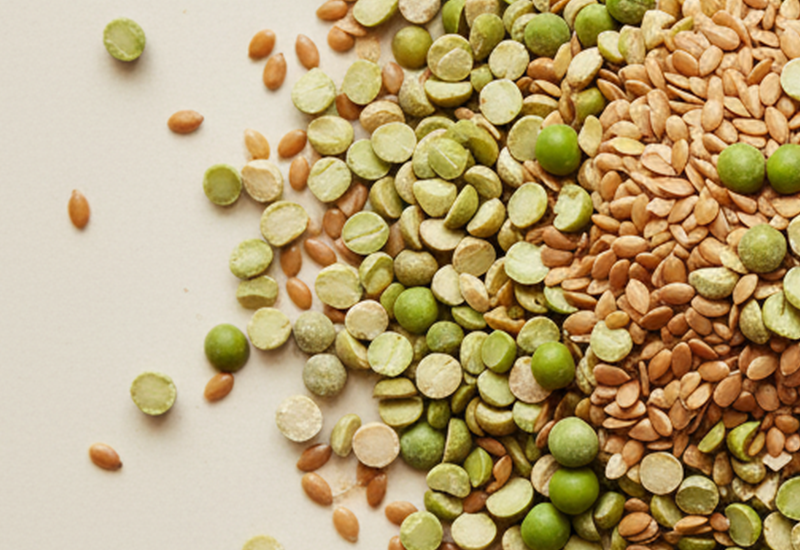
Protein comes from peas, faba beans, and brown rice. Carbohydrate from oats, tapioca, brown rice, pasta, or noodles, depending on the product. Fats from ground flaxseed, canola, and sunflower, with MCTs from coconut in some formulas. Fiber comes along with those plant ingredients. On top of all that sits the micronutrient blend, built to close the gap between what the food provides and what a balanced day needs.
We use flavors, sweeteners, and thickeners sparingly. A meal you don’t finish is nutritionally worthless, so taste and texture are part of the formulation, not an afterthought.
What we leave out: animal products, GMOs, artificial colors, and artificial flavors. Black Edition is sweetened with stevia. Gluten-free versions of Huel Powder use gluten-free oats.
We've done the thinking.
Some of this is complicated. Amino acid profiles, absorption, fatty acid ratios. It has taken serious research to get right.
None of that is yours to think about. That's the point of Huel. Open it, make it, go about your day.

References
- Institute of Medicine. Dietary Reference Intakes for Energy, Carbohydrate, Fiber, Fat, Fatty Acids, Cholesterol, Protein, and Amino Acids. Washington, DC: National Academies Press; 2005.
- U.S. Department of Agriculture and U.S. Department of Health and Human Services. Dietary Guidelines for Americans, 2020–2025. 9th ed. December 2020. Available from: https://www.dietaryguidelines.gov/
- U.S. Food and Drug Administration. Interactive Nutrition Facts Label: Dietary Fiber. Available from: https://www.accessdata.fda.gov/scripts/interactiveNutritionFactsLabel/dietary-fiber.cfm
- EFSA NDA Panel, 2010. Scientific Opinion on the substantiation of health claims related to protein... growth or maintenance of muscle mass (ID 415, 417, 593, 594, 595, 715)... EFSA J. 8, 1811.
- Jäger R, et al. International Society of Sports Nutrition Position Stand: protein and exercise. Journal of the International Society of Sports Nutrition. 2017; 14(1):20.
- LaPelusa A, Kaushik R. Physiology, proteins. In: StatPearls [Internet]. Treasure Island (FL): StatPearls Publishing; 2026. Available from: https://www.ncbi.nlm.nih.gov/books/NBK555990/
- EFSA Panel on Dietetic Products, Nutrition, and Allergies (NDA); Scientific Opinion on Dietary Reference Values for carbohydrates and dietary fibre. EFSA Journal 2010; 8(3):1462 [77 pp.]. doi:10.2903/j.efsa.2010.1462.
- Gallaher D. Dietary Fiber. Washington D.C.: ILSI Press; 2006. p. 102-10.
- Lin B-H, Guthrie J. Over time, racial and ethnic gaps in dietary fiber consumption per 1,000 calories have widened. USDA Economic Research Service, Charts of Note. March 28, 2023. Available from: https://www.ers.usda.gov/data-products/charts-of-note/106189
- Jéquier E. Carbohydrates as a source of energy. Am J Clin Nutr. 1994;59(3 Suppl):682S-685S.
- Brouns F, et al. Glycaemic index methodology. Nutr Res Rev. 2005; 18(1):145-71.
- Esfahani A, et al. The glycemic index: physiological significance. J Am Coll Nutr. 2009; 28 Suppl:439S-45S.
- Cocate PG, et al. Metabolic responses to high glycemic index and low glycemic index meals: a controlled crossover clinical trial. Nutr J. 2011; 10:1-.
- Kaur B, et al. The impact of a low glycaemic index (GI) diet on simultaneous measurements of blood glucose and fat oxidation: A whole body calorimetric study. J Clin Transl Endocrinol. 2016; 4:45-52.
- Stevens SL. Fat-Soluble Vitamins. Nurs Clin North Am. 2021 Mar;56(1):33-45. doi: 10.1016/j.cnur.2020.10.003. PMID: 33549284.
- National Institutes of Health, Office of Dietary Supplements. Omega-3 Fatty Acids: Fact Sheet for Health Professionals. Available from: https://ods.od.nih.gov/factsheets/omega3fattyacids-healthprofessional/
- Fornari Laurindo L, et al. Evaluating the effects of seed oils on lipid profile, inflammatory and oxidative markers, and glycemic control of diabetic and dyslipidemic patients: a systematic review of clinical studies. Front Nutr. 2025;12:1502815.
- Nagra M, Goldman DM, Belury MA, Messina M. Concerns about the health effects of industrially produced seed oils are without scientific foundation: a scoping narrative review of the clinical and observational evidence. Crit Rev Food Sci Nutr. 2026;66(27):5386-5445
- Deruelle F, et al. Vitamin C: is supplementation necessary for optimal health? Journal of alternative and complementary medicine (New York, NY). 2008; 14(10):1291-8.
- Combs J, et al. The Vitamins. 4th ed. Burlington: Elsevier Science; 2012.
- Sharma DC, et al. Correction of anemia and iron deficiency in vegetarians by administration of ascorbic acid. Indian J Physiol Pharmacol. 1995; 39(4):403-6.
- Siegenberg D, et al. Ascorbic acid prevents the dose-dependent inhibitory effects of polyphenols and phytates on nonheme-iron absorption. Am J Clin Nutr. 1991; 53(2):537-41.
- Graf E & Eaton J. Antioxidant functions of phytic acid. Free Radic Biol Med. 1990; 8(1): 61-9.
- Wilcox MD, Chater PI, Stanforth KJ, Williams R, Brownlee IA and Pearson JP (2022) A Pilot Pre and Post 4 Week Intervention Evaluating the Effect of a Proprietary, Powdered, Plant Based Food on Micronutrient Status, Dietary Intake, and Markers of Health in a Healthy Adult Population. Front. Nutr. 9:945622. doi: 10.3389/fnut.2022.945622
- Institute LP. Oregon State University α-Carotene, β-Carotene, β-Cryptoxanthin, Lycopene, Lutein, and Zeaxanthin. Available from: https://lpi.oregonstate.edu/mic/dietary-factors/phytochemicals/carotenoids
- Richer S, et al. Double-masked, placebo-controlled, randomized trial of lutein and antioxidant supplementation in the intervention of atrophic age-related macular degeneration: the Veterans LAST study (Lutein Antioxidant Supplementation Trial). Optometry. 2004; 75(4): 216-30.
- Daou C & Zhang H. Oat Beta-Glucan: Its Role in Health Promotion and Prevention of Diseases. Comp Rev Food Sci & Food Safety. 2012; 11(4): 355-65